
Kobe Steel and Samling sign LOI to collaborate on black pellet business feasibility study
Aug. 25, 2025
Kobe Steel, Ltd.
Kobe Steel announces that it has signed a Letter of Intent (LOI) with Samling Strategic Corporation Sdn Bhd*1 to conduct a comprehensive feasibility study on the construction of a black pellet production facility in Sarawak, Malaysia, exploring the prospect of producing and marketing black pellets*2, a raw material and fuel that contributes to reducing CO2 emissions.

Kobe Steel sees black pellets as a promising alternative resource that could help reduce CO2 emissions in power generation and ironmaking processes and aims to become a frontrunner in spreading their use both domestically and globally. To advance this initiative, Kobe Steel has collaborated with Mitsubishi UBE Cement Corporation (MUCC) to carry out a joint feasibility study for black pellets, as announced on May 15.
Since black pellets are not yet widely available worldwide, it is necessary to build a new supply chain that ensures stable procurement. We have made significant strides toward establishing a black pellet supply chain with the ongoing joint feasibility study with MUCC, which has advanced black pellet manufacturing technology, as well as the signing of the LOI with Samling, which has abundant and sustainable wood resources in Sarawak.
Kobe Steel and Samling plan to complete the joint feasibility study by the end of December 2025 and then determine whether to begin construction of the first black pellet production facility as early as 2026, based on the study results.
Kobe Steel will continue to seek collaboration with leading biomass wood pellet suppliers to build an even stronger black pellet supply chain.
Part of the study for the use of black pellets in the steelmaking process is conducted under the New Energy and Industrial Technology Development Organization (NEDO)’s commissioned and subsidized research and development project JPNP21019 (GREINS).
About KOBELCO-X
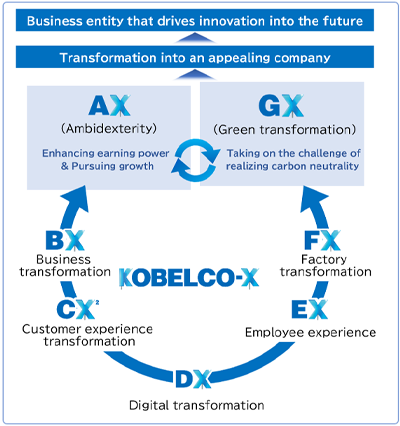
The Kobe Steel Group (also known as the Kobelco Group) is working on the transformation into an appealing company, as set out in its Medium-Term Management Plan (Fiscal 2024–2026). As part of this effort, we are advancing an initiative called KOBELCO-X, which spans a wide range of transformations. The joint feasibility study on black pellet production is linked to green transformation (GX), as the use of black pellets in the steelmaking process will contribute to decarbonization in the steel industry.
Our Group’s current Medium-Term Management Plan also aims to take on the challenge of realizing carbon neutrality as one of its priority issues. The Group will continue to move forward with its transformation initiatives by integrating its diverse technologies, products, and services in a unique way in order to become a more appealing company to all of its stakeholders with a view to a world in which people, now and in the future, can fulfill their hopes and dreams while enjoying safe, secure, and prosperous lives.
- Reference material:
Our Group’s Transformation Initiatives [PDF:7.88MB]
- *1Samling Strategic Corporation Sdn Bhd (based in Sarawak, Malaysia) is a Malaysian company that operates a variety of businesses, including forest resource management, oil palm plantation operation, and real estate development, and has a long-standing commitment to environmental protection.
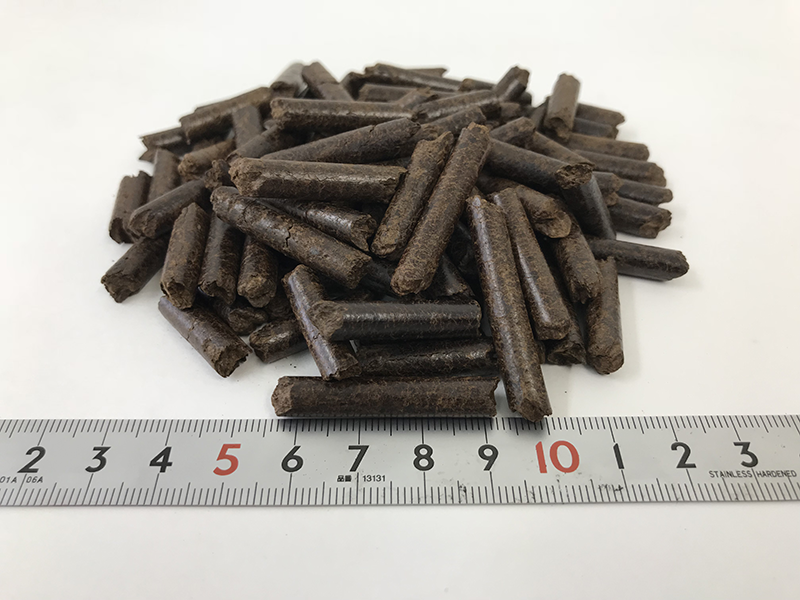
- *2Wood pellets, commonly known as white pellets, are a popular biomass fuel used around the world, including Japan. Black pellets, created through thermal treatment (torrefaction) of white pellets under specific conditions, have the heating value comparable to coal and are expected to be a low-CO2 alternative with the potential to be utilized as both a fuel for power generation and a raw material for steelmaking. White pellets are made from trees that have been cut for healthy forest development, as well as scraps and sawdust from the lumbering process and other underutilized timbers. Trees, which absorb CO2 as they grow, are considered as a carbon-neutral raw material and fuel. Using wood in steelmaking processes and thermal power plants can help to reduce the use of coal and contribute to decarbonization, while minimizing environmental impact. Since black pellets are a carbonized, water-resistant raw material and fuel, they can be stored in the open air, making it easier to prevent spontaneous combustion and implement other safety control measures. This enables us to use them as a raw material and fuel with lower risk and higher safety.
- *The information on this web site is presented "as is." Product availability, organization, and other content may differ from the time the information was originally posted. Changes may take place without notice.